
VANCOUVER, B.C., Nov. 5, 2026 (SEND2PRESS NEWSWIRE) — Humanity’s traditional understanding of Easter is due for a significant reconstruction and extension. So says researcher Mark Grant, who cites Palm Sunday as a key example.
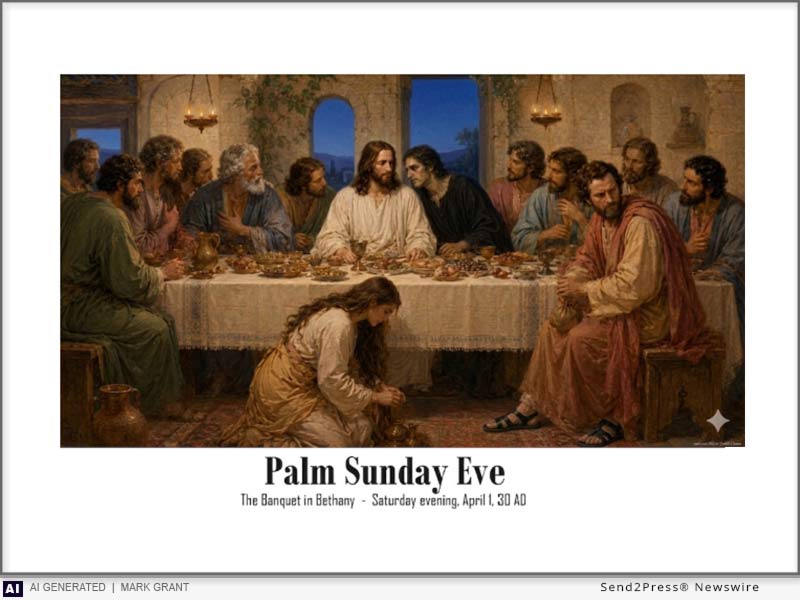
Image caption: Palm Sunday Eve. Credit: Mark Grant (AI generated image).
“In the traditional framing, we envision Jesus riding on a donkey as a crowd, perhaps dozens of people, lays down palm leaves on the path before him. Often one sees a gate that leads inside the ancient city.
“This kind of framing is highly medieval,” says Grant, “and therefore created during a time when Jerusalem’s surrounding landscape had long been barren. To see why the framing needs to be corrected, imagine turning around, so you see what was actually behind Jesus as he entered the city on Palm Sunday.
“Instead of seeing a barren landscape, you encounter a vast tent city, one that accommodates tens of thousands of visitors. Passover was one of several festivals that happened each year. For around five centuries, the festival overflow necessitated the creation of a canvas community that seems to have been overlooked in traditional presentations of the Easter story.”
During major festivals like Passover, outer Jerusalem likely accommodated between one hundred thousand to two hundred thousand inhabitants, says Grant, citing the famous historian, Josephus. The east side that Jesus rode his donkey through would have been largely populated by people from the north, where Jesus performed most of his miracles over the three previous years.
“Starting the Easter celebration on Palm Sunday and working our way forward has come with a surprisingly high cost,” Grant contends. “Very few Christians know that Jesus raised Lazarus exactly one week earlier.
“For all the attention placed on Holy Thursday these last two thousand years, how many Christians have ever considered the idea of Jesus and the apostles dining with a formerly dead man just five days before the Last Supper?”
Now available for open-access release via CERN’s Zenodo repository, Grant’s latest work, “A Reconstruction, Necessary Extension, and Synchronistic Evaluation of Christianity’s Easter Narrative,” offers an unprecedented and extended view of the Easter story.
“After Lazarus rose from the dead, scriptures direct our attention to the High Priest Caiaphas, who called a secret meeting of the Sanhedrin where they plotted to kill Jesus. By focusing on the main players we seem to have overlooked the fact that the Lazarus resurrection would have settled a major theological debate that had been raging among the masses for around two hundred years in Judea since the Maccabean Revolt. Jesus’s raising of Lazarus proved that the Pharisees and the general public were correct about the afterlife, and that Caiaphas and other Sadducees were wrong.”
Alluded to in Luke 24:18, where Cleopas incredulously asks Jesus on the road to Emmaus, “Are you the only visitor to Jerusalem who does not know the things that have happened there in these days?” Grant suggests that the Lazarus episode marked the birth of that Passover’s explosive “Jesus News Feed”.
“Caiaphas was likely informed of the Lazarus resurrection within less than an hour,” he says. “At the same time this piece of news must have spread quickly through a very cramped Bethany-Jerusalem corridor. Think first-century social media.
“For the next few days, Lazarus would have had to make himself somewhat available for viewing, and not just to appease the curious. Many people had gone to the time and expense of attending his funeral. Through their verification process, people would have also confirmed that the miracle-worker, Jesus, was involved. But Jesus was nowhere to be found, having slipped away to nearby Ephraim with the apostles. There must have been intense speculation regarding his whereabouts.”
Next, on what Grant calls Palm Sunday Eve, Jesus and the formerly dead Lazarus dined in Bethany with the apostles. With Sabbath walking restrictions lifted at sunset on Saturday, many people would have left Bethany to tell others the latest Jesus news. He predicts that word of Jesus’s return would have reached much of greater Jerusalem by the next morning — when the traditional Easter story begins.
“Until now, the Palm Sunday crowd’s enthusiasm seems to have been attributed to the totality of the miracles that Jesus performed over the previous three years. The Lazarus episode suggests something far more specific. After Jesus got off his donkey and entered Jerusalem, thousands of east-side pilgrims would have been wondering, ‘What will happen with Jesus next?’
Long left out of frame, Jerusalem’s collective consciousness suggests that the Passion was a much more public story than traditional framing allows.” Rather than change the liturgical celebration of Easter, Grant simply suggests that we extend the Easter story inwardly to include the Lazarus episode, which demands integration because it functions like a preview of Jesus’s resurrection.
After making that case, he guides the reader through the Passion from an unprecedented public point of view, revealing an urban landscape while offering new perspectives on classic Passion stories—such as Jesus’s Monday Temple disruption, his arrest in Gethsemane, and how Jesus’s tomb likely functioned like a high-profile museum on Holy Saturday, making the masses wonder what might happen on the “third day,” which locals would have thought of as Nisan 16.
Insights like these legitimize a much broader question: Exactly how much information has gone overlooked, through our traditional tendencies to focus on surface text and medieval framing, for up to two thousand years?
“Take the eternal mystery regarding whether John the Baptist and Jesus knew each other growing up,” says Grant. “With males expected to attend Jerusalem festivals at least three times a year, Jesus and John must have gotten to know each other quite well over three full decades. Add their unique births and noted family connections, and the mystery may seem to be solved beyond all reasonable doubt.”
As Grant sees it, the dating of the crucifixion has become another unnecessary mystery.
“In theory, there are two possible years for the crucifixion since we know that Jesus died on a Friday Passover. Obviously, one must be wrong; and one happens to be based on a very well-known calendar error (introduced by Dionysius Exiguus) 1,300 years ago. Christian churches have chosen for that long to not address the error. In doing so, they have turned a solvable puzzle into a theological blind spot.”
Grant ends this groundbreaking work by showing how the correct year for the Passion aligns in synchronistic fashion with major episodes that include, but are not limited to, the Exodus and the conclusions of both Temple eras.
Although preliminary, the abundance of Passion synchronicity data is already on par with the finer examples of Grant’s research on modern synchronicity studies, raising the intriguing possibility that the Passion may contain more sync data that is waiting to be discovered. (For more information, see “QSD-123: Global Synchronicity, the Scientific Method, and Three Datasets That Classical Science Cannot Explain.” – https://zenodo.org/records/23570251 )
Contact the Author at: https://quantitativesynchronicity.com/contact/
News Source: Researcher Mark Grant