JINAN, Shandong, China, Aug. 31, 2026 (SEND2PRESS NEWSWIRE) — Shandong Renke Control Technology Co., Ltd., a leading manufacturer of environmental monitoring sensors and solutions, is bringing conventional and ultrasonic measurement technologies together in its wind monitoring portfolio to address the evolving requirements of applications that depend on continuous and reliable wind data.
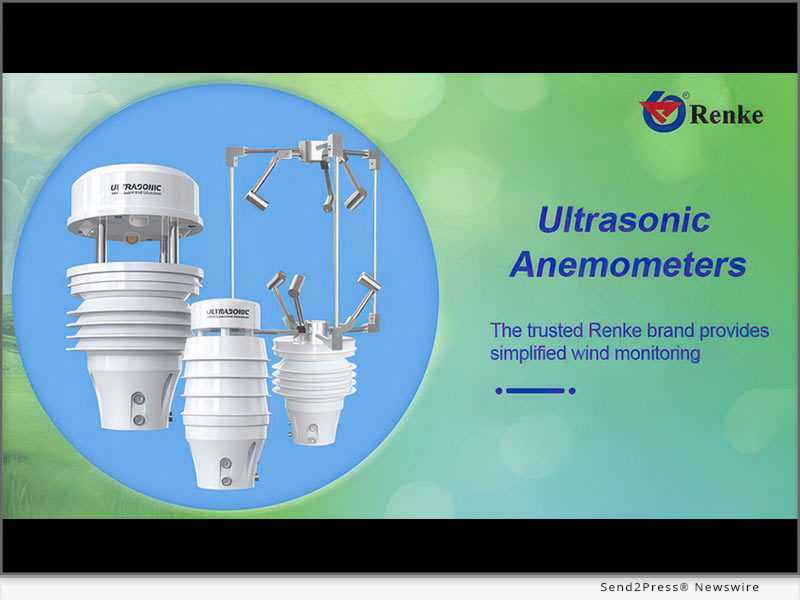
Image caption: Renkeer ultrasonic anemometers.
Wind data now supports far more than daily forecasts. Renewable energy operators track it to schedule turbine maintenance and estimate output. Port and marine authorities use it to clear cargo and crane operations. Aviation-adjacent facilities, road traffic managers, smart city planners, and infrastructure engineers depend on continuous wind speed and direction readings to protect bridges, cranes, and tall structures, and to support environmental compliance records.
Agricultural operations, laboratories, and coastal research stations add their own accuracy and durability requirements. As wind monitoring spreads across more industries, the gap has widened between what a single sensor type delivers and what a full monitoring program actually needs.
These requirements have made it difficult for a single wind measurement technology to address every application. Conventional wind speed and direction sensors remain suitable for many established monitoring systems, while ultrasonic technology provides an alternative approach for applications where the absence of moving measurement components, continuous operation and fast response are important considerations. For more complex airflow environments, 3D ultrasonic anemometers can provide additional information about vertical and horizontal wind components.
Even so, buyers still have to choose between two-dimensional ultrasonic models built for standard horizontal readings and three-dimensional units needed for vertical airflow, turbulence, or gust analysis. Sourcing mechanical and ultrasonic technology from separate suppliers has typically meant separate specifications and support contacts, adding friction to projects that mix sensor types on one site.
Renkeer’s wind sensor series is built to close that gap with three tiers under one specification and support structure:
Conventional wind speed and direction sensors use a three-cup or vane design in a polycarbonate or aluminum housing, with a 0-70 m/s measuring range and RS485, 4-20mA, 0-5V, 0-10V, or pulse output. They suit budget-sensitive, high-volume deployments such as greenhouses and general-purpose weather stations.
Ultrasonic wind sensors have no moving parts and a built-in electronic compass that removes directional alignment work during installation. It can withstand wind speeds up to 75 m/s. That combination fits ports, road traffic monitoring, and other sites where all-weather reliability and fast installation matter more than upfront cost.
3D ultrasonic anemometers use six ultrasonic probes across three axes. They measure wind speed on the X, Y, and Z axes plus horizontal and vertical wind direction, sound velocity, and acoustic temperature in a single reading, for wind farm performance assessment, marine research, and laboratory-grade turbulence studies.
The combination of these technologies is intended to address a range of environmental monitoring requirements rather than promote a single measurement method. All three tiers connect to the same free cloud platform, so a site running mechanical, 2D ultrasonic, and 3D ultrasonic sensors side by side can still review every reading, log, and calibration record from one dashboard rather than three separate systems.
Potential applications include automated weather stations, environmental monitoring networks, agricultural meteorological monitoring, building and urban environmental monitoring, and other outdoor systems where wind conditions need to be continuously measured and recorded. By offering multiple measurement approaches within one product portfolio, Renkeer aims to simplify technology selection while giving system integrators greater flexibility when designing monitoring equipment.
“Customers used to have to choose a technology first and a supplier second, then repeat the process for every tier of accuracy they needed on a site,” said Binda, Director at Renkeer. “Building the mechanical, 2D ultrasonic, and 3D ultrasonic sensors on one product line lets a customer specify by application instead, and still get the same output options, calibration data, cloud platform, and support behind every unit.”
VIDEO (YouTube): https://youtu.be/bMxbQow_2-E?si=-hUM8Iqe5y_5m68w
ABOUT RENKEER
Shandong Renke Control Technology Co., Ltd. (Renkeer) is a Jinan, Shandong, China-based manufacturer specializing in the R&D, production, and sales of intelligent environmental monitoring terminals and control systems. Products including temperature and humidity sensors, wind sensors, water quality sensors, soil sensors, gas sensors, and weather stations. With more than 15 years of manufacturing experience, Renke’s products carry CE, ISO 9001, FCC, and RoHS certification and are distributed through agents across Asia, Africa, the Americas, Europe, and Oceania.
Address: High-Tech Zone, Jinan, Shandong, China
Website: https://www.renkeer.com
###
MEDIA ONLY CONTACT:
(not for print or online)
Helen
Phone: +86 15628902292
Email: helen@tempandhumidity.com
News Source: Shandong Renke Control Technology Co.,Ltd.